The Coming of Maitreya Buddha - A New Vajrayana Practice - I
Updated: Jul 14

The meditative work on the Zodiac-Mandala of the Heavenly Jerusalem is like a Vajrayana practice connected with many Divine Masters and Personification of the Divine Feminine. In Buddhism, Vajrayana, or the Diamond Vehicle, is an esoteric tradition, the initiation ceremonies of which involve entry into a Mandala, a mystic circle or symbolic map of the spiritual universe. With the Mandala of the Heavenly Jerusalem, we have something like a new Vajrayana which provides a basis for receiving the initiations of all world religions. At the same time the Mandala of the Heavenly Jerusalem serves as a basis for the integration of all religions showing their unique place and importance in the spiritual life of humankind.
Similar to the Buddhist Mandala, the main initiations at the four cardinal points can be presented in a symbolic form through different spiritual characteristics such as universal direction, earthly manifestation of the Divine Spirit, feminine counterpart, element, colour, posture and others. In order to describe the essence of the initiations at the cardinal points of the Mandala of the Heavenly Jerusalem, however, we have to introduce many more spiritual characteristics and concepts: cosmic phase, universal principle, mission, view of earthly life, type of transcendence, spiritual practice, model of the universe, structure of creation, spiritual transformation of the human being, symbol of initiation, sublime state of consciousness, ultimate reality. Then, with the help of all these spiritual characteristics and concepts, we can, based on key words, model the initiations of Babaji, Buddha, Jesus Christ, the Master Beinsa Douno and the Holy Spirit, situated at the cardinal points of this Mandala. The initiations at the four cardinal points form the main typological structure of the Mandala of the Heavenly Jerusalem. All other initiations gravitate to one or another of these four types depending on their place on the Mandala.
As part of the new Vajrayana practice, in the next two Posts I will introduce a few characteristics of the Initiations at the four cardinal points of the Mandala of the Heavenly Jerusalem such as View of Earthly Life, Character and Direction of Transcendence, Element, Symbol of Initiation, Spiritual Colour and Ultimate Reality. I believe they will provide a good basis for reflection, contemplation and meditation.
View of Earthly Life
In accordance with the spiritual seasons, the symbolic image of earthly life varies from initiation to initiation. For the Hindu tradition, which came at the beginning of the involutionary cycle, the earthly life is maya, illusion, unreality. The Earth is not the true homeland of humankind. Human beings have a higher Divine origin but have forgotten it, erroneously interpreting existence on Earth as the true reality. They will not however remain in the thraldom of illusion forever. They are children of Light and must pierce through the cosmic illusion and disperse it.
In the Buddhist tradition (originating in the cosmic Autumn which brings a balance between spirit and matter) earthly life is a perfect field for enlightenment but only as an opportunity to escape from it by reducing the lust for life. Moreover, of all living creatures, human beings alone, and only on Earth, can attain the state of Nirvana and reach enlightenment - that is, become a Buddha. All other creatures, even the most Divine ones, must be born as human beings on Earth in order to attain Nirvana.
In Christianity, the earthly life, reflecting the spiritual coldness of the cosmic Winter, is portrayed as a 'desert of life' where hate and hard-heartedness reign and where human beings are neither enlightened by Wisdom, nor warmed by Love, nor spiritualised by Truth. The life of human beings on Earth during the epoch of the cosmic-spiritual Winter necessitates suffering and spiritual crucifixion but the acceptance of the Christ impulse leads to resurrection and eternal life. So, in Christianity, earthly life is a spiritual prison where Christ, experienced historically as Jesus Christ, spiritually as the Love in the hearts of people, and cosmically as the Light of the World, descended as Saviour to set us free. Only the first born of God, God the Son, could stop the process of human involution in darkness and set in motion the wheel of evolution bringing light and immortal life.
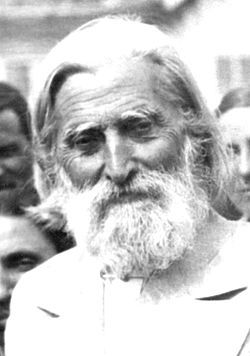
Contrary to the Buddhist conception, in the Master Beinsa Douno's initiation (during the evolutionary process of the cosmic Spring when we have again a balance between matter and spirit) the earthly life is not only a field for enlightenment, but a great spiritual school where we work on every life situation and relationship. Behind Nature and the various processes in human life stands the span of evolution, the age-long work of natural, social and cosmic-spiritual forces. When the disciples become aware of the spiritual energies inherent in earthly life, they understand the great efforts necessary to produce these conditions and appreciate the blessings and possibilities given to them for spiritual development. Then they give thanks from the depths of their hearts and begin to perceive life on Earth as a great spiritual school.
In the epoch of the cosmic Summer the earthly life will become a life in the Garden of Paradise. People initiated by the Holy Spirit will have direct contact with God and the spiritual hierarchies which uphold the mineral, plant and animal kingdoms. All forms of life will be enlivened in the reality of the Spirit. The initiation of the Holy Spirit brings a unique opportunity to fulfil the greatest dream in the history of humankind - returning back to the Garden of Paradise. Unlike the Hindu and the Christian approach to earthly life, in the epoch of the Holy Spirit the earthly life itself has to become life in the Garden of Paradise.
So, during the various seasons of the cosmic-spiritual year, the perception of earthly life changes dramatically: from maya and illusion, through a neutral field for enlightenment, to a desperate desert of life; then, in accordance with the evolutionary process, it becomes a great spiritual school and finally - the basis for celestial life on Earth. Such different viewpoints of earthly life determine the completely different directions of the spiritual paths leading towards initiation.
Character and Direction of Transcendence
It is amazing how the directions of the paths leading towards initiation (or in other words, the transcendence to the higher states of consciousness) differ in the various spiritual traditions. The character and direction of transcendence depends on the cosmic-spiritual season and the view of earthly life. Accordingly, the type of transcendence determines the spiritual practices for each tradition.
In the Hindu path, the person must overcome the limiting boundaries of maya (the cosmic illusion) and penetrate to the true reality of Being - the all-embracing Divine Light. Therefore, the transcendence is vertical and upward. The liberated human consciousness must be able to perceive only the creative Divine Light rather than the manifested material world of forms. This process of dissolving all forms into the reality of Light makes the transcendence extraverted.
The Buddhist path turns within, to the intimate mechanisms of the human mind - i.e. the transcendence is introverted. Because 'samsära and nirväna are one' (See Lama Anagarika Govinda, Foundations of Tibetan Mysticism, p. 89) we don't need to go anywhere else, but simply to overcome our ignorance. We are in the same reality but we have to change our attitude towards it - so the transcendence is 'horizontal'.
The Christian path shows the way to the reality of the Kingdom of God. We have to ascend upward from the material life to the higher spiritual worlds (the transcendence is vertical, ascending upward). In order to achieve this goal, however, we have to go deeply within ourselves and to activate the Christ essence within (so the transcendence is intraverted).
The path of the Master Beinsa Douno's spiritual school is one of externalisation of the spiritual laws, methods and principles in our daily life. In the epoch of the cosmic Spring the spiritual disciples are supposed to have given birth to the Christ impulse within and then, with blossoming souls, they live in the material world as in a joyful spiritual school. So, the transcendence is extraverted because the disciples emerge from the subjective, psychological dimensions of life and direct their attention to the external world. It is 'horizontal' because the disciples seek the spiritual in the field of earthly life, in the inexhaustible richness of concrete forms, relationships and social structures.
The type of transcendence in the initiation of the Holy Spirit is vertical, but descending downward, and extraverted. The initiation of the Holy Spirit inspires human beings to connect with the spiritual aspect of all things and to start working for the enlightenment of the whole earthly life. In this respect their spiritual practice is extraverted (from the inner to the outer). It has a vertical direction, but orientated downwards, because the purpose is to bring the reality of the Kingdom of God down on Earth (compare with the Hindu path which is vertical and extraverted as well, but ascending upward trying to rise above maya, the cosmic illusion).
We can summarise that on the horizontal axis of the Mandala the transcendence is always horizontal, due to the balance between spirit and matter, but either introverted or extraverted in accordance with the process of involution (during the spiritual Autumn) or evolution (during the spiritual Spring). On the vertical axis the transcendence is always vertical, but ascending upward or descending downward, either introverted or extraverted in accordance with the process of 'subjectification' or 'objectification' (see Scheme 1). The transcendence in the Hindu initiation and in the initiation of the Holy Spirit is both vertical and extraverted, but they differ in direction - ascending upward or descending downward. This comes as result of the difference between the beginning of the process of involution (as is the case in Hindu tradition) and the end of the process of earthly evolution (which results in the initiation of the Holy Spirit).
The type of transcendence is a very important characteristic of every spiritual path. It helps us to understand them much better and to compare the aims and spiritual practices of the various traditions. In our epoch we are witnessing much discussion and argument between the followers of different spiritual paths. But, of course, there is no reason for polemics because the different traditions simply realise different types of transcendence in accordance with the spiritual seasons and lead ultimately to the same Divine Origin of Being. At the same time, what a wonderful opportunity for humankind to experience the whole bouquet of spiritual paths, each one with its exquisite and unique fragrance.


Comments